
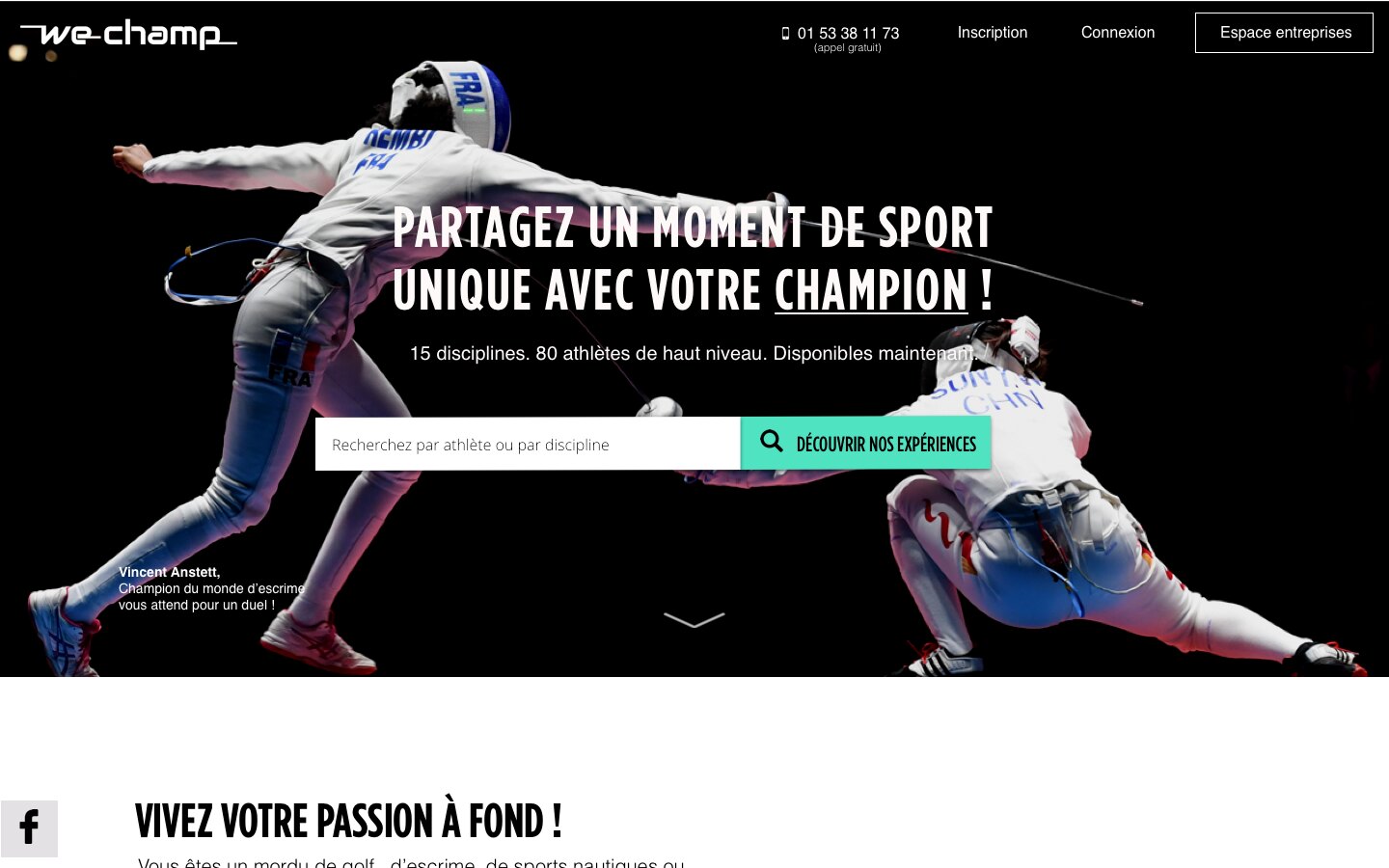
WeChamp connects athletes with companies or clubs, around sporting experiences. The design approved in May 2017 states the promise in one line, share a unique sporting moment with your champion, and the volume behind it: fifteen disciplines, eighty top-level athletes, and a search by athlete or discipline at the top of the home page. The site had to be a catalogue, and a catalogue is not built by stacking pages. It is modelled.
In pictures
The project in detail
Three content types were therefore created in WordPress: athletes, experiences and sports. Each has its data model and its templates, an athlete's page, the athlete list, an experience's page, the experience list, a sport's page. All three are linked, so an athlete points to their experiences, an experience to the athlete running it, and a sport to everyone who practises it. That internal linking is what gives the site its coherence and, incidentally, its search surface.
A fourth, less visible type carried the theme's options: editorial settings live in the admin interface rather than in the code, so the client can change a label or a featured item without anyone intervening.
Two very different audiences arrive on the site, and each got its own pages: a companies area, for away days and team building, and a clubs and associations page. The client's specification, annotated screen by screen, also asked for precise journey elements: a booking button present at all times, anchors to the reviews at the foot of the page, a multiple selection of sports showing how many are chosen, a form that keeps the experience being viewed at the moment of sending.
The work was done in two separate repositories, a bespoke theme and a functionality plugin, and that split is not a flourish. The four content types live in the plugin: if the theme changes one day, the data stays. Both repositories are tooled like software, with Composer, a gulp chain and a code style check run by a test command, which is rare on a WordPress site of this size.
The image on this page is the approved design, not a capture of the site. The site's media were not recovered from the old server, and a catalogue page without its athlete photographs would show nothing of what was delivered. The designs and the annotated specification are in the archives: they are what makes it possible to describe the journey with this precision.