
EVEZ works on risk prevention and assessment. The project started from a simple, demanding idea: rather than explaining to visitors what they do not know, put them in a position to be wrong, then show them reality. The vehicle is a quiz, but its mechanics are not those of a form, and none of it was bought off the shelf. There is no quiz plugin here and no page builder: the engine, its data model, its tables and its endpoints were written for this project.
In pictures
The project in detail
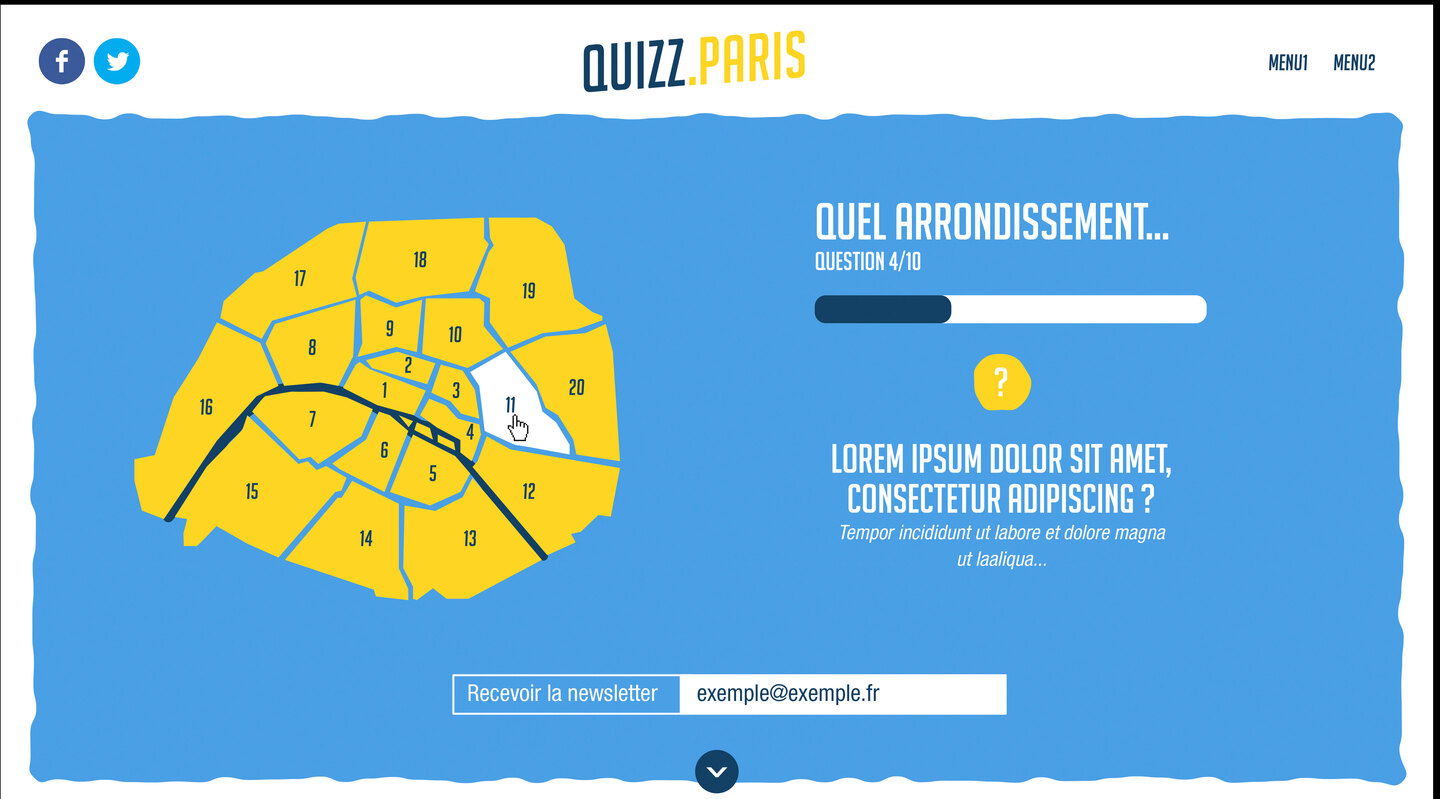
The question is closed and its possible answers are the districts of Paris. Visitors do not pick from a dropdown: they click an interactive map. The selected district turns green if they were right, red if not, and the correct answer then appears in green beside it. The site then shows the real levels of each district, which give the measure of the gap, and the success rate for that question, computed from the answers already given.
That last point is what holds the whole thing together. The theme creates its own tables, one for the answers and one for newsletter sign-ups. Every answer is written there with its timestamp, the question id, the chosen answer id and a visitor id drawn from a cookie, with no account and no sign-up. A dedicated endpoint reads those rows back and returns the percentage shown to the next visitor.
An optional survey extended the quiz, to gather detail on the respondent's stance towards risk. It has its page on the site, but it was served by an off-the-shelf survey tool rather than rebuilt. That was the right split: the quiz was the bespoke piece, the one that existed nowhere else; a multiple-choice survey was not.
Ten questions, asked over the yellow map of the twenty districts embedded as SVG in the page. The questions and their answers are not written in the code: they live in repeatable admin fields, so the client could change them without us. Technically the site is a WordPress built with Bedrock and a Sage theme written for this project, with its own page templates. The repository carries one configuration file per environment, development, staging and production, a gulp chain for stylesheets and scripts, and a GitLab CI pipeline. For a mini-site that is a lot of rigour, and it is precisely what let the project take the traffic an awareness campaign was expected to bring.
The same year EVEZ entrusted us with hosting its application. We set up two virtual servers behind a load balancer, in a configuration where one server carries the whole load and the other takes over in case of incident. The choice between that strategy and an even split was settled with the client's technical director.