Where to start with AI in a business?
Not with an assistant that does everything. AI projects that last start with one precise, repetitive and measurable task: sorting documents, extracting amounts, answering questions from a document base, drafting something a human validates. You can then compare before and after, and decide to go further or stop.
I help you pick that first task, gather the data it needs, then build a usable prototype in days rather than a study lasting months.
The best candidates are often modest: checking supporting documents, sorting incoming requests by topic, finding in a document base the answer to a frequent question. They share a repetitive volume, a checkable result and someone able to tell whether the answer is right.
Extracting data from documents
Labelit, an internal tool, sends photos of till receipts to a Mistral document recognition model and gets structured output back: merchant SIREN, date, amounts before and after tax, VAT at several rates. Each result is validated by a Pydantic schema, each file is renamed by convention, and a summary table is produced.
The lesson is general: ask the model for structured output and validate it with code, rather than trusting free text. That is what makes automation reliable and checkable.
Searching your content: RAG and GraphRAG
RAG, retrieval augmented generation, finds the relevant passages of your documents and gives them to the model so it answers while citing its sources. GraphRAG goes further by organising knowledge as a graph: entities, relations, provenance.
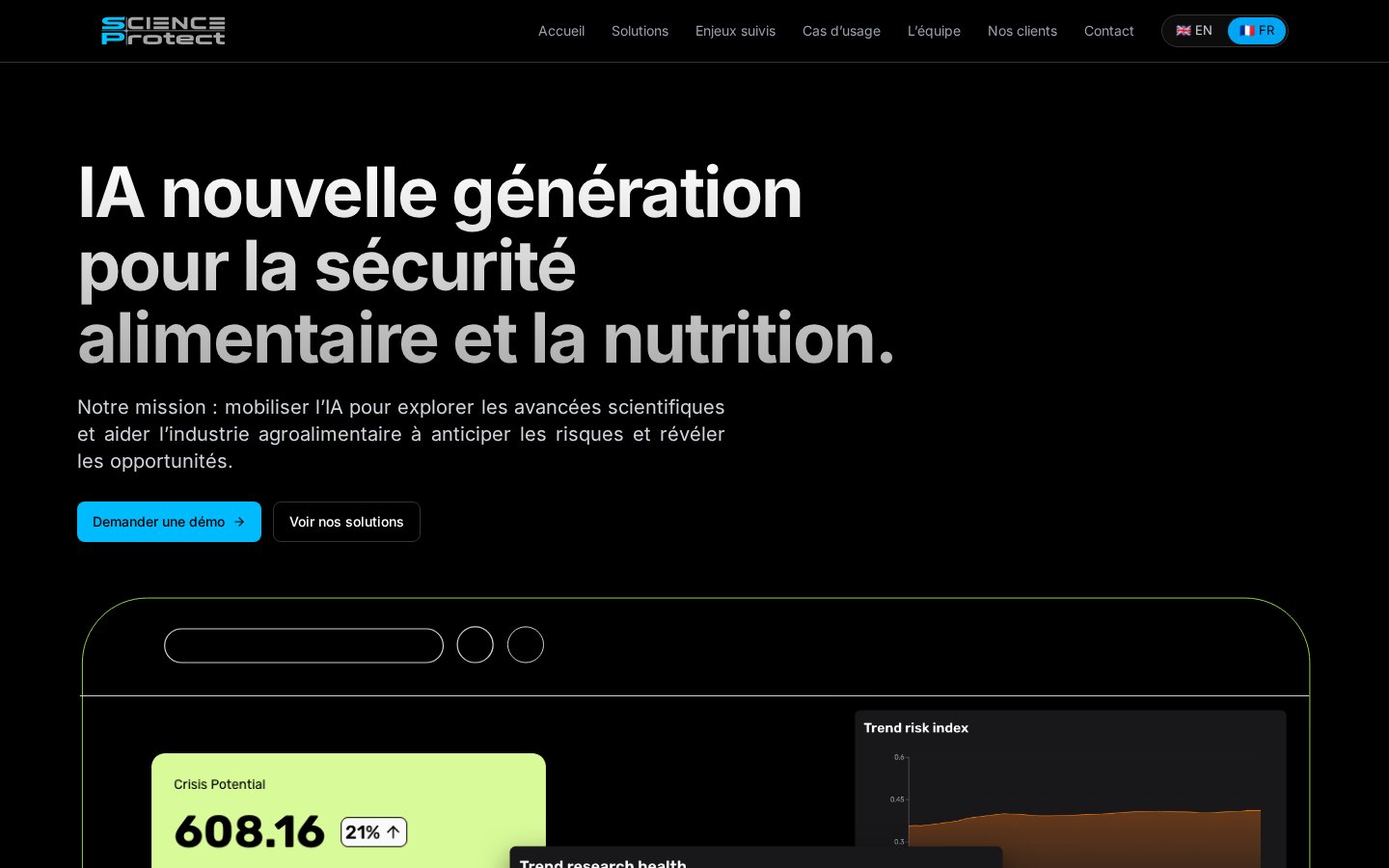
On ScienceProtect, a scientific monitoring platform, I took part in building a Memgraph knowledge graph linking substances, diseases, foods, publications and EFSA experts, queried by agents with validation of the generated queries. It was team work. For this kind of project, the sister studio Arbre Agile carries the specialised offer.
Agents integrated into your tools
A useful agent calls your existing tools: your API, your database, your messaging. I write it with libraries such as pydantic-ai, with typed outputs, logs of every call and clear limits on what it may do. Irreversible actions stay validated by a human.
I pay attention to confidentiality: which data goes to which model provider, and under what terms. A European provider such as Mistral is sometimes the right choice for that reason.
How I check that an AI tool works
Before connecting a model to a real process, I build with you a small set of examples with known answers: documents already processed by hand, questions whose answer is in your sources. The tool is measured on that set, then again at every change of model, prompt or provider. You know what it gets right, what it misses, and whether a new version is better or worse.
In production, every call is logged with its inputs, output, duration and cost. On the ScienceProtect knowledge graph, queries generated by agents are validated before they run against the database, and monitoring relies on dedicated observability tools. These guardrails are what make it possible to hand a task to a model without watching it all the time.
From prototype to a tool people use
A prototype that impresses in a demo is not enough. For an AI tool to be used, it must fit where the team already works: a button in the back office, automatic processing when a document arrives, a report sent every morning. So I build the integration alongside the model, with an API, background tasks and an interface when one is needed. And I plan from the start what happens when the model provider is down: a queue, an automatic retry, or manual processing flagged to the team.
What AI will not do for you
It does not replace a poorly defined process, and it makes mistakes: every project I deliver plans how to detect and correct them. I do not sell productivity figures without measuring first, and I will tell you when a simple script or business rule beats a language model.